 The cuts are most evident on the air at WPLJ, where Christine Richie and Dave Stewart are both off the air. Richie had been doing nights, and Stewart had been working the overnight shift, the latest stop on a 22-year career for him at the station. Stewart had another line of work going as well – he also runs his own production company, Creative Broadcast Audio – but the end of his run on overnights is still a sad sign of what’s coming as Cumulus tries to pay for its big Citadel purchase.
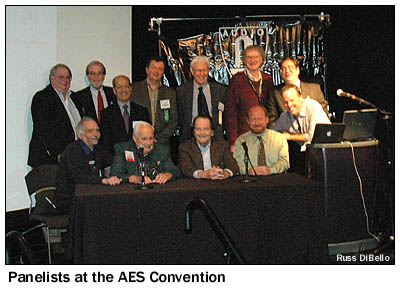 The Audio Engineering Society returned to New York City last week for their 131st convention, and your editor was honored to co-chair a particularly notable panel discussion Friday night commemorating the 50th anniversary of FM multiplex stereo in the United States.
 That would mean the end of the Curtis (Sliwa) and (Ron) Kuby morning show that’s become a fixture on WABC, and indeed, Kuby signed off last Monday by saying what sounded like a farewell to his audience…except that no official announcement of the change followed, and indeed, a week later there’s still been no confirmation from Citadel management that it’s bringing Imus back to the airwaves, or that Kuby’s really gone from the station.
 Carr and his legal team are appealing the ruling; Carr’s not returning to WRKO willingly; and in the meantime both WRKO’s afternoon shift (hosted, for the moment, by Todd Feinburg) and WTKK’s morning drive (where Michael Graham is holding forth for now) remain in limbo. (With, we’d note, the looming question of a new Boston home for Imus if he does indeed return to syndication – could that be WRKO’s cue to cut its losses on the flailing Tom Finneran morning show and install former WTKK fixture Imus in its morning slot?)
NorthEast Radio Watch 4/15/2024: Broadcasters Gather in VegAIs
In this week’s issue… AI, virtualization hot topics at NAB - WBAI faces second site eviction - CBS Sports Radio affiliates rebrand - New morning show at Y108 - Remembering Mister Cee

In this week’s issue… Bell/Astral is off: what now? – What can Cumulus do with WFME? – Where will Family Radio go on AM? – Airstaff shakeup in Syracuse – WCME debuts in Maine
By SCOTT FYBUSH
*Over the last decade or so, this column has repeatedly wondered just how far the authorities in CANADA will allow media consolidation to proceed before deciding enough is enough. Late last week, just as we were processing the latest round of FM-cluster consolidation in the biggest market in the U.S. (about which, more in a moment), the CRTC declared that line had been reached, denying Bell’s C$3.38 billion proposal to add Astral Media’s 84-station radio group and 20-network cable TV portfolio to its existing roster of media and communications holdings.
 When we outlined the potential size of a Bell/Astral combination in the March 19 edition of NERW, it seemed like the perfect combination for Bell: Bell would propose to spin off radio stations that exceeded local market caps (as indeed it did), but would still end up with a much larger radio footprint that included plenty of smaller Ontario markets and a toehold in French-language Quebec radio that Bell had been lacking. On the TV side, Astral’s French-language cable holdings would have meshed nicely with Bell’s CTV broadcast and cable empire. And from all we could see back in March, there was no reason to think the CRTC would have departed from its usual policy of rubber-stamping every bit of consolidation that came its way.
But then came Montreal – and what just might have been the little bit of over-reach that doomed the entire deal. In addition to Astral’s two French-language FMs, Bell would have ended up with its own CKGM (990, moving to 690) and Astral’s three stations, CJAD (800), CJFM (95.9) and CHOM (97.7). That was one station too many for the English-language side of the Montreal market, but Bell didn’t want to put any of those stations up for sale, so it instead proposed converting CKGM from English-language “TSN Radio” to French-language “RDS Radio,” a move that would have shifted the signal into the French side of the market where the Bell/Astral combination would have remained beneath the ownership cap.
And even that move might well have passed CRTC muster…if Bell hadn’t just gone before the agency a few months earlier to plead for a signal upgrade for CKGM. Bell made some big promises during that hearing, arguing that it needed to shift “TSN 990” to 690 in order to better serve the Anglo audience that’s predominantly based on the west side of the Montreal market. Against the backdrop of the language politics that have once again been flaring in Quebec this year, it’s no wonder that Montreal’s Anglophones felt angered and betrayed when Bell proposed to flip CKGM, just as the station was in the midst of making its big frequency change. Interventions opposing the Bell/Astral sale and the CKGM flip began pouring into the CRTC in record numbers, so many of them that CRTC officials openly complained that their summer holidays had to be cancelled to give them time to review all the public comments.
In the end, the CRTC says it received just shy of 10,000 public interventions “from broadcasters, distributors, independent producers and creative groups, citizen and consumer advocacy groups as well as from individuals from all parts of Canada.”
The CRTC’s response was scathing: “The proposed transaction would not only remove the last major independent, non-integrated broadcaster from the system, but transfer its undertakings to the largest vertically integrated broadcaster and telecommunications service provider in Canada. With the combination of the largest and third largest participants in discretionary television services (by revenue), one entity would control more than 63% of revenues from French-language discretionary services. This would represent more than five times the revenues generated by the next largest competitor in that market.” And despite Bell’s contention that the Astral deal would create an entity that could provide real competition to Quebecor’s dominant conglomeration of cable TV, broadcast and newspapers, the CRTC says it is “of the view that BCE did not demonstrate how the proposed transaction, which would result in the vast majority of French-language programming services being held by two large, vertically integrated competitors, would invigorate competition.”
Bell fared no better with its radio proposals. The CRTC says its proposed spinoffs of ten stations (including FM pairs in Ottawa and Toronto) “can be viewed as an attempt by BCE to trade underperforming stations for successful ones, which would not provide a benefit to the Canadian broadcasting system or create the conditions for healthy competition.” Oh, and as for CKGM? The CRTC didn’t say much about that proposal even as it rejected it – but it did indicate that it expects Bell to live up to its promise to continue to operate the station as an English-language outlet if the switch to French were not approved.
 *What happens now? Bell quickly fired back at the CRTC with a petulant press release, vowing to appeal the denial to the federal cabinet, which has already said it won’t overturn the CRTC’s decision. In Montreal, media guru Steve Faguy reports that “privately,” staffers at CKGM were “thrilled” at the stay of execution they received…and that questions are already swirling about what might become of Bell’s plans for RDS Radio. The French-language network would have filled a void created when Cogeco abruptly flipped Montreal’s CKAC (730) from sports to provincially-subsidized traffic reports, but if it’s not going to happen on 690, the AM options have slimmed dramatically in recent years as other broadcasters have applied for and been granted new signals on previously-vacated channels including 600 (TTP’s proposed English-language talker), 850 (a newly-proposed TTP French-language sports-talker), 940 (TTP’s French-language talker) and 990 (Evanov’s Radio Fierte, due to launch next year after CKGM vacates 990 for good).
And then there’s Astral, which still holds a valuable portfolio of radio and cable networks, and is still presumably a target for acquisition by someone else. Could a smaller (but still substantial) player like Shaw, Corus, Newcap or Vista (which just received the CRTC’s blessing to buy Haliburton’s Ontario stations) or Evanov take a run at some or all of Astral? About the only players we can categorically exclude are Cogeco and Quebecor, which would create an even greater concentration of Quebec media ownership.
*While Canada pushes back against ownership consolidation, the trend pushes ever forward in NEW YORK, where the third big station sale this year had the market talking last week.
 As you know from our mid-week update, Cumulus is adding a third station (or fourth, depending on how you look at it) to its New York cluster with the acquisition of WFME (94.7 Newark) from Family Stations.
MONDAY MORNING UPDATE: We now know the price tag for the deal – as rumored, Cumulus will pay Family $40 million for the WFME license, and will transfer WDVY (106.3 Mount Kisco) in northern Westchester County to Family. Family will lease Cumulus the current WFME transmitter facility for a dollar a year for five years, and then $1,000 a month for the following five years – unless Cumulus moves WFME into New York City, in which case it will pay Family an additional $8.5 million (if it moves as a B1) or $10 million (if it moves as a class B signal.)
Now that the initial buzz around the deal has had a few days to die down, let’s take a deep, NERW-style look (based, as usual, on a mix of our own market analysis, insight from trusted industry sources and some informed speculation) on what Cumulus can do with its new toy:
[private]
*Elsewhere in New York, the big action last week came in Syracuse, where Hunter Scott and Josh Grosvent disappeared very abruptly from their morning show on Cumulus’ WAQX (95.7 Manlius) after dropping a series of clues about a “zombie attack” on the show’s Twitter feed on Monday and on the air on Tuesday. On Wednesday, the news broke that crosstown Galaxy had dismissed most of the airstaff at WKRL (100.9 North Syracuse)/WKRH (106.5 Minetto)/WKLL (94.9 Frankfort-Utica). Gone from “K-Rock” were Dex Mitchell (mornings), Nixon (middays/PD) and Candace Curby (nights). And on Thursday, CNYRadio.com confirmed the speculation: Scott and Grosvent had signed on as the new morning team at K-Rock. By Friday morning, Cumulus had served a cease-and-desist letter on Scott, Grosvent and Galaxy; instead of signing on at 6 on Friday morning at K-Rock, Scott and Grosvent reportedly spent an hour and half talking things over with Galaxy CEO Ed Levine before deciding to go on the air anyway.
“Slavery was outlawed 150 years ago in this country,” Levine told the Post-Standard on Friday. Scott and Grosvent say they can’t possibly be in violation of the terms of their expired Cumulus contract, which required them to at least negotiate in good faith for a new contract before heading across town. That, the duo says, is because Cumulus refused to talk to them…until the moment the C&D letter arrived. Will there be legal fireworks coming as the 95X/K-Rock battle enters its next chapter? Bet on it.
*In Albany, Laura Daniels has departed morning drive at Pamal’s WYJB (95.5) – and she says she’s now headed for a morning shift in Buffalo, with speculation pointing to the vacant chair at Townsquare’s WJYE (96.1).
 *NEW JERSEY‘s most unusual radio station is about to expand its reach in New York’s Rockland County. WFMU (91.1 East Orange) has been relaying its freeform independent programming into the Orange County area for many years now on WMFU (90.1 Mount Hope), and now it’s adding a translator to fill part of the gap between the two signals. WFMU’s licensee, the nonprofit Auricle Communications, will pay Digital Radio Broadcasting $125,000 for translator W219DQ (91.7 Dillyville), but it’s moving the translator from its present location in Orange County, where it’s been relaying Sound of Life’s WLJP (89.3 Monroe), to New City in Rockland County. Once the translator moves to 91.9, it will have new calls W220EG – and we suspect the main reason it’s worth so much to WFMU to be heard in Rockland and Orange counties has to do with the station’s long-running “Jewish Moments in the Morning” show, and with the huge population of Hasidic Jews in the region.
*The biggest AM array in PENNSYLVANIA has fallen silent for now. With nine towers, the 10 kilowatt signal of WKGE (850 Johnstown) has been a challenge to maintain for several owners and operators.
 Most recently, it’s been owned by Birach Broadcasting (best known for its leased-time ethnic stations) and operated by Mike McKendree’s “Edge” talker, WWGE (1400 Loretto) – but that lease ended last week, and now 850 is silent under special temporary authority. Birach has put the station up for sale and is actively seeking buyers through Pittsburgh broker Ray Rosenblum; in the meantime, it may return to the air with an interim format.
There’s a new LMA in Hazleton, where WAZL (1490) is broadcasting nonstop Christmas music while new operator Ken Medek’s KMCS Broadcasting LLC prepares a variety hits format to take the air in January. Medek is better known, of course, as “Doc Medek,” morning man at Philadelphia’s WXTU (92.5) and former Wilkes-Barre/Scranton jock at WGGY and WKRZ.
*TV People on the Move: Pittsburgh’s WTAE (Channel 4) has named a new news director. He’s Justin Antoniotti, inbound from Hearst sister station WYFF in Greenville, S.C. to replace the departed Alex Bongiorno. And over at NBC affiliate WPXI (Channel 11), the hunt is on for a replacement for news director Mike Goldrick, who’s leaving after three years on the North Side to become vice president of news at NBC O&O WRC (Channel 4) in Washington.
*It was a busy radio week in MAINE, starting in Bangor, where “Mike and Mike” are ending a 15-year run at Blueberry Broadcasting’s “Kiss” (WKSQ 94.5 Ellsworth), with Mike Dow heading to WBAK (104.7 Belfast) and sister station WABK (104.3 Gardiner) and Mike Elliott joining Katrina Walls on WBFB (97.1 Bangor) and its “Bear” country sisters in Rockland and Bar Harbor, WMCM (103.3) and WLKE (99.1).

Up the coast in Brunswick, Jim Bleikamp became the second independent local AM operator in the region last week when he flipped the switch to return WCME (900) to the airwaves. It was a long road back for the little station, which had started out as WCME back in 1955 and spawned an FM sister on 98.9 that eventually became Portland-market WCLZ-FM.
A sale of the FM station took away the AM facility on the FM tower, and the silent license was sold to Bob Bittner, who kept it alive through brief periods diplexing on his own WJTO (730 Bath) tower before selling the license to Bleikamp, who’s best known for his long run as the voice of the Wall Street Journal‘s radio service. And Bleikamp (with the assistance of engineer extraordinaire Mark Humphrey) in turn went through a long fight to find a new tower site.
Now the fight is done, and the station took the air to the sounds of John Lennon’s “Number 9 Dream” on Tuesday, kicking off a new full-service format that Bleikamp describes as “70s-focused hits with some surprises in the form of “lost” classics and rock ‘n roll from the garage,” and that he says will ultimately evolve into “local-local-local,” with a morning show and hourly local newscasts coming in a month or so.
*In NEW HAMPSHIRE, questions are still swirling around the sudden departure of Chris Garrett from the PD chair at Clear Channel sister stations WGIR-FM (101.1 Manchester) and WHEB (100.3 Portsmouth). The “Doctor of Rock” started at WGIR almost 30 years ago, moved to WHEB a few years later, and eventually added WGIR-FM back to his portfolio when Clear Channel combined management of both stations.
*Christmas music returned to the eastern MASSACHUSETTS airwaves this week, at least for HD Radio owners. CBS Radio’s WODS (103.3 Boston) was usually one of the first stations to start ho-ho-ho’ing this time of year, but its main channel flipped from classic hits to top-40 “Amp” earlier this year, and so this year the Christmas tunes are on WODS-HD3.
 The Christian contemporary “Mercy Rock” format that had been there has reportedly shifted over to WBMX (104.1)’s HD3, displacing the psychic talk that was heard there. (Did they see it coming?)
In Fall River, Steve Kass is coming home to WSAR (1480) beginning next week to do the 3-6 PM show. After starting his career at WSAR, Kass went on to a long career doing talk in RHODE ISLAND at WHJJ and WPRO before leaving radio a few years back to work for the Rhode Island Emergency Management Agency and Big Brothers of Rhode Island.
*Joseph Rosenmiller was Peter Bordes’ partner way back in 1956 when the two young broadcasters bought WESO in Southbridge, and the little company they founded back then grew into something much bigger. That, of course, was Greater Media, and Rosenmiller retained partial ownership of the company until 1994. He died in New York last Sunday (Oct. 14) at age 87.
*And back to Canada we go: Evanov (through its subsidiary Dufferin Communications Inc.) has been granted a second signal in the Montreal area. As we noted earlier in the column, Evanov will soon put “Radio Fierte” on the air on 990, serving the city’s gay and lesbian community in French – and now the CRTC has also granted its earlier application for a new 500 watt/94 m signal on 106.7 in Hudson/St. Lazare, out to the west of Montreal. The new station will broadcast in English, using the same “Jewel” soft AC format heard on Evanov’s CJWL (98.5 Ottawa) and CKHK (107.7 Hawkesbury).
Speaking of Ottawa, CFRA (580) has hired former Ottawa Sun publisher Rick Gibbons to host a new block of programming from noon until 3 on weekdays. The new CFRA schedule drops “Ottawa Noon,” Rick Corbett at 1 PM and the first hour of Rob Snow’s afternoon show to make room for Gibbons.
And in Windsor, the CRTC has given the CBC the go-ahead to move CBEF, its Radio-Canada premiere chaine affiliate, from 540 to 1550. CBEF will use the facilities vacated last year by the old CBE (1550, now CBEW 97.5); those towers were in better shape than the aging 540 transmitter site. CBEF will also add a new FM transmitter in Sarnia, at 98.3.
[/private]
 *Good news, everybody! The 2013 Tower Site Calendar is finally back from the printer this week, and on its way out to YOU!
This is the 12th edition of our annual calendar, which features photos of broadcast towers taken by Scott Fybush on his travels.
The 12-month wall calendar boasts a full-color photo each month of a well-known broadcast transmitter site.
This year’s edition includes sites in Florida, Wisconsin, Kentucky, California, Iowa, Idaho, Las Vegas, Colorado, Boston, Cleveland, Albuquerque, upstate New York and western Massachusetts. We’ve also redesigned the calendar to make it more colorful (don’t worry; the pictures are still pristine) and make the spiral binding our standard binding — your calendar will hang even better on your wall now! And of course, we still have the convenient hole for hanging.
Order 20 or more for a 10% discount! And while you’re at the Fybush.com store, check out the new National Radio Club AM Log and the final stash of FM Atlas editions.
For more information and to order yours, click here!
From the NERW Archives
Yup, we’ve been doing this a long time now, and so we’re digging back into the vaults for a look at what NERW was covering one, five, ten and – where available – fifteen years ago this week, or thereabouts. Note that the column appeared on an erratic schedule in its earliest years as “New England Radio Watch,” and didn’t go to a regular weekly schedule until 1997. One Year Ago: October 24, 2011 – *The first signs of Cumulus Media’s takeover of the Citadel radio group emerged late last week in NEW YORK, and they’re not pretty: at least a dozen people are out of work at the Two Penn Plaza headquarters of what are now Cumulus’ largest stations, WABC (770) and WPLJ (95.5).
On WABC, Mancow Muller’s local weekend show got the ax, though he’ll continue with his national syndicated show over at Talk Radio Network. Most of the other cuts at WPLJ and WABC happened off the air: WPLJ general sales manager Helen Hammel is gone, as is WABC producer Jill Vitale (known as “Flirty Flipper” during her days producing Sean Hannity). So far, the latest round of Cumulus cuts seem to be limited to the former ABC Radio stations that passed through Citadel on the way to Cumulus; the stations that had been with Citadel longer, in smaller markets such as Syracuse and Portland and Erie, were already pretty lean when Cumulus took over and have thus far been spared much of the pain. *A controversial Manhattan FM translator wants to try again on a new frequency. NERW was the first trade publication to begin chronicling the story of what started out as W296BT, on 107.1 in Brooklyn, back in November 2009 – but when we wrote back then that the translator grant was “just the start of what promises to be an interesting saga,” little did we know how interesting it would get. The translator didn’t stay on 107.1, or in Brooklyn, for very long: it migrated temporarily to 106.5 from a site near the western mouth of the Holland Tunnel in New Jersey, then attempted to slip back into Manhattan as W292DV, operating on 106.3 with 99 watts from the top of Four Times Square. Translator owner “Apple 107.1 Inc.” (Michael Celenza) attempted to run the station as a relay of the HD2 signal from Clear Channel’s WLTW (106.7 New York), but was quickly shut down by interference complaints from Press Communications’ WKMK (106.3 Eatontown NJ), which enjoys a significant fringe-signal audience because its “Thunder Country” format is otherwise unavailable in New York City and vicinity. Now the translator is asking for an FCC waiver of the usual minor-change rules to allow it to move to a non-adjacent channel: it’s applying to relocate to 104.7, where it would run 70 watts from a directional antenna atop Four Times Square. The move won’t run into opposition from its new Manhattan neighbors, since Clear Channel owns both WAXQ (104.3) and WWPR (105.1) on the second-adjacent channels. And while Apple 107.1 says it expects the new channel won’t run into the same interference complaints that doomed the 106.3 operation, NERW notes that the 104.7 application’s contours come within a fraction of a mile of the protected contour of another signal on 104.7, Pamal’s WSPK Poughkeepsie – and “K104.7” was putting a nicely listenable signal into the NERW-mobile as we drove down the west side of Manhattan late last week. Will Pamal follow the lead, ironically, of Clear Channel, which quashed a co-channel translator in Detroit (also on 104.7, nicking at the northern contour of Clear Channel’s WIOT Toledo)? In that case, the FCC strongly enforced the piece of its rules that prevents translators from causing any interference to reception of a licensed full-power station, even outside that station’s normal protected contours. If those rules are strictly enforced in New York City, it’s hard to imagine any open frequency to which this translator could move…but, as always, stay tuned for the next chapter.
What you see at left is a collection of some of the most important innovators in FM stereo’s history, including (second from left, seated) Dick Burden, the last surviving member of the 1961 committee charged with selecting a standard for FM stereo. The panel also included processing gurus Bob Orban, Frank Foti, Eric Small and Bill Sacks, as well as Belar founder Arno Meyer, engineers Richard Mertz and Herb Squire and the NAB’s Skip Pizzi. (It was webcast, and we’re hoping to be able to offer a link to archived audio and video in an upcoming edition of NERW.) As Pizzi noted in his closing remarks, FM stereo has outlived a whole host of more highly-touted broadcast technologies – and as Sacks pointed out, it’s one of the few technologies that became a world standard, with the only competition, now defunct, coming from the Soviet polar-modulation scheme. *Norman Corwin’s name is no longer well known in the contemporary radio community, but there was a time when Corwin was a giant on the radio landscape. A native of Boston, Corwin began his broadcast career in Springfield in the early 1930s as a newsman at WBZA, sister station to Boston’s WBZ. By 1936, he’d moved to New York City to work at the new WQXR, and two years later he was working for CBS as the creator of “Norman Corwin’s Words Without Music.” World War II brought Corwin his biggest successes, including the valedictory show “On a Note of Triumph,” which aired to an audience of 60 million listeners on VE Day in 1945. Corwin went on to travel the world, producing the documentary series “One World Flight” before turning to screenwriting in the 1950s. As he aged, Corwin remained remarkably active, creating a series of radio dramas for NPR in 1979 and then repeating the feat in 2001 (“More by Corwin”). Up until his 100th birthday last year, Corwin was still teaching at the University of Southern California – and answering e-mails from admirers, your editor included. Corwin died last Tuesday (October 18) at age 101, perhaps the last great living link to the Golden Age of Radio. Five Years Ago: October 22, 2007 – *If NEW YORK radio listeners – at least those who listen to WABC (770) in the mornings – are a little confused this week, we don’t blame them. After all, it’s been a week now since the Drudge Report “confirmed” that Don Imus would be heading to WABC for morning drive, beginning December 3.
Is Imus really coming to WABC? Probably…but we’d expect a more coordinated announcement from Citadel than what we’re seeing so far, if only to provide Kuby a more dignified exit. (Sliwa will stay with WABC, says the rumor mill, perhaps in what’s now John Gambling’s midday slot.) Poughkeepsie’s WKIP (1450) is taking another stab at the news-talk format, several years after flipping to standards. The all-syndication lineup includes Pittsburgh’s Quinn and Rose in morning drive, as well as Glenn Beck, Rush Limbaugh, Mark Levin, Sean Hannity and Michael Savage. With former PD/morning host Paul Vandenburgh heading over to the competition (Regent’s WTMM 1300), Pamal’s WROW (590 Albany) has picked a replacement: former WGY talker Scott Allen Miller, most recently heard in mornings at Boston’s WRKO, comes to WROW to direct programming and host the morning show. *It’s not just the Curtis/Kuby/Imus transition that’s not going quite the way it was meant to go – in MASSACHUSETTS, Howie Carr continues to fight the ruling that’s preventing him from making the jump from Entercom’s WRKO (680) to Greater Media’s WTKK (96.9). Earlier last week, Suffolk Superior Court Judge Allen van Gestel ruled in Entercom’s favor, saying it had the legal right to match WTKK’s offer, and thus to keep Carr’s services locked up until 2012.
Amidst all the turmoil at Entercom Boston, there’s one morning host whose position is stable as can be: Greg Hill has signed up for another five years in morning drive on WAAF (107.3 Westborough), with no walkouts, lockouts or lawsuits needed. (Congratulations…) In Du Bois, PENNSYLVANIA, WDBA (107.3) ended more than three decades of independent Christian broadcasting last Monday, when the station changed hands from the Du Bois Area Broadcasting Company to upstate New York-based Family Life Ministries, which has turned WDBA (and its Clearfield translator at 103.7) into a simulcast of its region-wide Family Life Network. *In CANADA, an AM-to-FM move has yielded a new format in Kingston, Ontario. CFFX-FM (104.3) had been testing for a month or so before turning on a simulcast of oldies CFFX (960) two weekends ago) – and then last Monday, it launched for real with an AC format as “Lite 104.3 FM.” Milkman UnLimited reports that the former CFFX air staff, including Dave Holmes and Ray Bergstrom, remain on the air. The AM signal’s still on the air for now, too, simulcasting “Lite” until it signs off for good in a few weeks’ time. Ten Years Ago: October 21, 2002 – Like it or loathe it, Ibiquity’s “HD Radio” system now has the official blessing of the FCC (all day for FM, daytime only for AM) — and New York’s WOR (710) couldn’t wait to be first in the country to sign on with the system. FCC approval came Thursday, October 10, and when the sun rose over New Jersey the next morning, “WOR-HD” was on the air, to decidedly mixed reviews. Since receivers for the digital system aren’t yet available, the initial reaction came from analog listeners. At least among the trained ears of the medium-wave DX community, the initial reports suggested that WOR’s analog audio, constrained by the bandwidth requirements of the digital signal, sounded much thinner than usual. And since the “in-band, on-channel” system actually utilizes bandwidth from adjacent channels as well, there were immediate reports of significant digital hash as far down the dial as 690 kHz and as far up as 730 kHz. We’ll have more thoughts in the weeks to come about the viability of the “HD Radio” system for AM, in particular where night service is concerned…stay tuned. We’ll go to PENNSYLVANIA next, and we’ll start right at the western edge of the state, where WAKZ (95.9 Sharpsville) will get to double power to 6 kW as part of a three-way deal with other stations near its frequency in adjoining parts of Ohio. WNPQ-FM (95.9 New Philadelphia OH) will go up to 4.1 kW and WEEL (95.7 Shadyside OH) will go from a class A to a class B1 operation with 6.75 kW. What’s behind it all? Clear Channel, mostly; WAKZ is the Youngstown market “Kiss” station and WEEL is part of the company’s Wheeling cluster, and CC was happy to sign off on a bit more interference to its WAKS (96.5 Akron) and WKST-FM (96.1 Pittsburgh) in exchange for more power in each market. The real “more power” winner this week was WAMO-FM (106.7 Beaver Falls), which left behind its old tower overlooking Beaver Falls (still in use by former sister station WBVP 1230) in favor of a new site in Wexford, along I-79 north of target market Pittsburgh. WAMO lost some Pittsburgh audience a few years back when it traded away its huge signal on 105.9 to Clear Channel (it’s now modern rock WXDX) in exchange for the Beaver Falls stick, which served Youngstown better than Pittsburgh most days; this move will help the urban station get its signal back to the neighborhoods it’s targeting anyway. Fifteen Years Ago: October 23, 1997 – We’ll start, for a change, up in MAINE, where an out-of-state broadcaster is buying into the Bangor and Augusta markets in a big way. Cumulus Broadcasting, which owns 8 AMs and 27 FMs in the midwest, is picking up rocker WTOS (105.1) Skowhegan from Mountain Wireless, and country WQCB (106.5) Bangor and CHR WBZN (107.3) Old Town-Bangor from Castle Broadcasting. Mountain Wireless keeps its other Skowhegan properties (sports simulcast WSKW 1160/WHQO 107.9 and AC WCTB 93.5 Fairfield). WTOS has long been a dominant station in much of central Maine, with a potent signal from the top of Sugarloaf Mountain (hence the “TOS” calls and the “Mountain of Rock” nickname) that reaches Augusta, Bangor, and south almost to Portland. WQCB, better known as “Q106”, is the market-leading country station in Bangor, while WBZN (“Z107.3”) is an up-and-coming CHR outlet. Don Imus made the rounds of his Maine affilaiates this week, stirring the controversy over his Bangor affiliate’s aborted plan to decorate a local landmark in his honor. WWMJ (95.7 Ellsworth) was denied permission to put a “Welcome to Bangor, Mr. Imus!” T-shirt on the giant statue of Paul Bunyan downtown. To prevent future disputes, Bangor city leaders have now banned all clothing on city-owned statues in the future…and Imus devoted a chunk of Tuesday’s show in Bangor to ribbing the mayor and other officials about the decision. Imus also visited Portland affiliate WZAN (970), broadcasting from there on Wednesday. Moving west to NEW HAMPSHIRE, Concord’s RadioWorks group is expanding its regional reach with the purchase of WNHQ (92.1) in Peterborough. WNHQ will drop its current AC format on November 3 to become a simulcast of adult CHR WJYY (105.5 Concord). The staions will be known on-air as “New Hampshire’s Hottest Hits, 105-5 JYY and 92-1 NHQ.” This will be RadioWorks’ second Granite State simulcast; classic rockers WNHI (93.3 Belmont) and WRCI (107.7 Hillsborough) have been simulcasting as the “I-stations” for several years. Longtime WSMN (1590 Nashua) general manager Maury Parent has been dismissed by the station’s board of directors, after allegedly throwing a mouse pad at a WSMN employee, who then filed assault charges against Parent. In RHODE ISLAND, Providence’s WLKW (790) made the long-rumored switch to an all-sports format Monday morning, sending the adult standards format (and eventually the WLKW calls) down the dial to WPNW (550) Pawtucket-Providence, which is using a not-quite-legal ID of “W-P-N-W-L-K-W Pawtucket/Providence” at the moment. |

In this week’s issue… AI, virtualization hot topics at NAB - WBAI faces second site eviction - CBS Sports Radio affiliates rebrand - New morning show at Y108 - Remembering Mister Cee
In this week’s issue… Darkness on the edge of NERW-land - WQZS leaves the air - Remembering WBXL's Jenner, Stern's "Crazy Cabbie," Pittsburgh's O'Brien
In this week’s issue… Alhart sets end date - WNBC's Scarborough hits 50 - Garabedian relaunches WJIB - Rogers rebrands in Toronto - One less "Nash" in PA - Albany meets "Zoey"
In this week’s issue… FCC cracks down on Nexstar's WPIX deal - Remembering WBZ's Shaw - More new LPFMs all over