

 Imus will take a pay cut from his old CBS Radio salary to return to the airwaves; reports have him earning about $5 million a year from the deal, which will also bring back his former WFAN newsman Charles McCord. (What of producer Bernie McGuirk? Nobody’s saying, and there are rumors that McGuirk may be pursuing his own new show in the Boston market.)
 In central Pennsylvania, WXPN (88.5 Philadelphia) spent last week celebrating its big facility upgrade, having traded the former WXPH (88.1 Harrisburg) for the 7 kW signal of WZXM (88.7 Middletown).
NorthEast Radio Watch 4/15/2024: Broadcasters Gather in VegAIs
In this week’s issue… AI, virtualization hot topics at NAB - WBAI faces second site eviction - CBS Sports Radio affiliates rebrand - New morning show at Y108 - Remembering Mister Cee

In this week’s issue… Region recovers from Sandy – WFAN-FM launches – WKTV’s Worden retires – Station sales on Cape Cod, northern VT – Final end for RCI Sackville
By SCOTT FYBUSH
NOTE TO SUBSCRIBERS: As many of you hit subscription renewal time, we’re in the process of upgrading our subscription system. In the meantime, if you’re experiencing difficulty renewing your existing subscription, please click here to renew. Thanks for your patience!
*The last time a storm ripped across the Jersey shore and Long Island Sound with the intensity of last week’s Hurricane Sandy, the year was 1938 and the broadcast damage was extensive and long-lasting.
With just a few exceptions, Sandy left behind much less permanent damage, but its effects on the broadcast community were still plenty intense in the short term. As we chronicled all throughout last week in updates to NERW, the combination of massive power and telecom outages and record-high water levels in low-lying areas left stations struggling to stay on the air in the hours and days immediately after the storm.
We’ll get to the latest station-by-station details in a moment, but first a few bigger thoughts about how radio and TV fared not only in surviving the storm, but in covering it.
We were fortunate up here in western New York (as we so often are) to escape the worst of the storm. Our colleague Lance Venta of RadioInsight.com was not so fortunate; he lives near the Jersey shore, and while his home wasn’t damaged, he spent several days stranded without power, listening carefully to what radio offered, and to what it didn’t offer. In other trade publications, you’re already reading radio executives praising the industry for the service it provided during the storm – but be sure, too, that you read Lance’s account of what wasn’t there when he needed it. Here’s just a highlight – but go read the whole thing:
At the peak of the storm only two local FM’s were in full storm mode. New York Public Radio’s 93.9 WNYC-FM and Disney’s 98.7 WEPN-FM, the latter of which was simulcasting the programming of sister WABC-TV. Some other stations had local break-ins but for those fearing their lives what good is it that Taylor Swift is never getting back together?
The NAB has been on a crusade to have FM chips placed in cell phones using crises such as this as a reason why. That’s all and good, but without the content the listeners need what good is it?
On with our detailed review of the storm’s aftermath and the latest on the recovery –
[private]
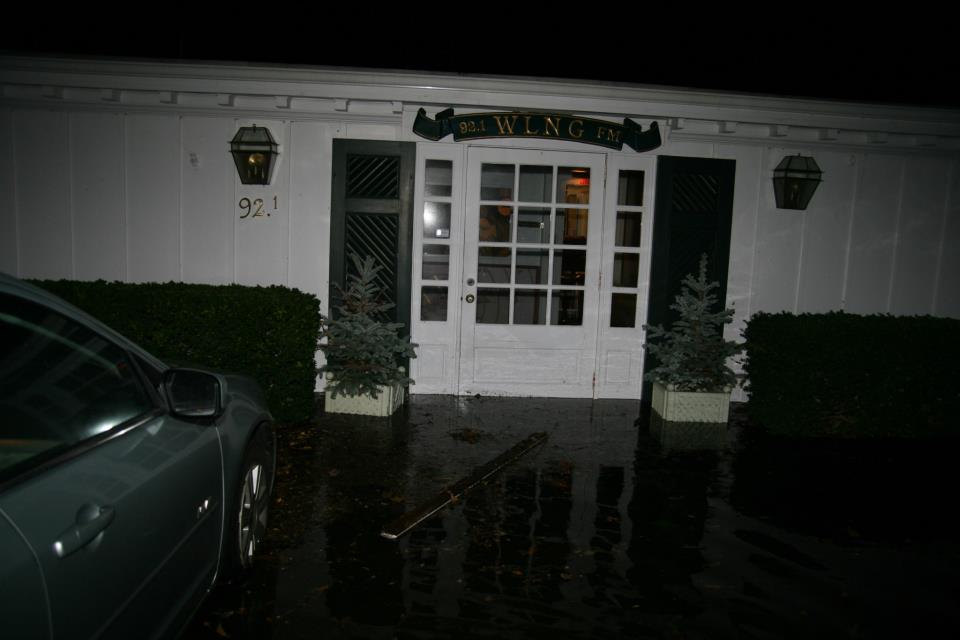
Perhaps the best review that can be offered is that the service broadcasters provided was decidedly mixed. As ever, there were a handful of top-notch local stations that went all-out to provide nonstop local coverage. Out on Long Island’s East End, WLNG (92.1 Sag Harbor) kept going even as water was rising into its studio building Monday night, and its commitment was matched in other parts of the region by stations such as WGHT (1500 Pompton Lakes NJ), WRNJ (1510 Hackettstown NJ) and WOND (1400 Pleasantville/Atlantic City, silenced on AM but simulcasting on sister WWAC 102.7) that kept on chugging with hyper-local storm information.
Other areas, as Lance notes, were not so fortunate. Connecticut’s Fairfield County, at the edge of storm-swelled Long Island Sound, suffered plenty of storm damage and long-lasting power outages, but lacked a strong local news outlet, especially after the storm crippled WICC (600 Bridgeport), the area’s biggest local AM signal, along with other local stations such as WGCH (1490 Greenwich). That left several other players to try to pick up the slack with more limited news resources – Cox’s WPLR (99.1)/WEZN-FM (99.9) went wall-to-wall with coverage at the height of the power outages, and public radio WSHU-FM (91.1) tried to pour more resources into the local AM signals it picked up from Cox, WSTC (1400 Stamford)/WNLK (1350 Norwalk), to respond to criticism that their local news operations had been silenced by the sale.
Storm damage and power outages made it hard to get information to central Long Island as well. WALK-FM (97.5 Patchogue) was displaced from its low-lying studios and decamped to emergency studios at the Suffolk County emergency operations center, but the FM signal ended up losing power and leaving the air, with WALK programming heard only on the weaker WALK (1370) for a time. WHLI (1100 Hempstead) simulcast News 12 Long Island for several days, including during the nighttime hours when the daytimer is usually silent.
Local news was hard to come by up the Hudson Valley, too. There were (and still are) extensive power outages in areas such as Rockland County, which lacks much local radio – and the local station that does broadcast in English, WRCR (1300 Spring Valley), lost part of its center tower and is operating at reduced power, non-directionally, in the meantime.
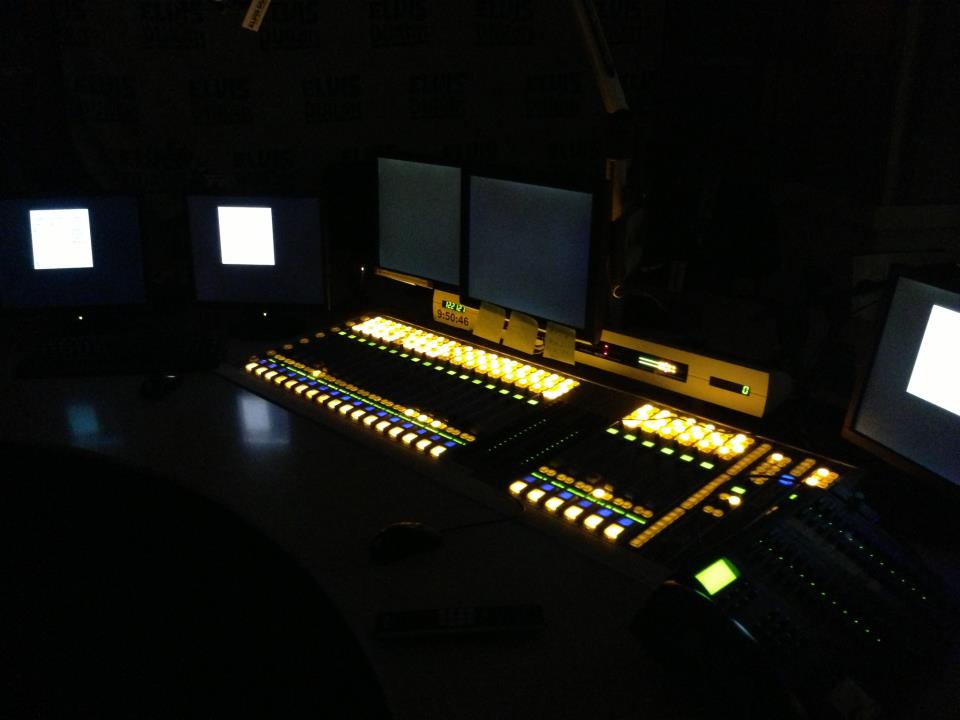
In New York City, the mass migration of studios from expensive midtown Manhattan office space to cheaper lower Manhattan ended up causing problems. There were power outages of varying durations at the studios of CBS Radio, Clear Channel, WOR, Emmis, Multicultural Broadcasting and WBAI. And even in the places where power was quickly restored via generator or studio operations shifted to backup facilities elsewhere (such as Clear Channel’s backup studio in Secaucus, N.J., where automation quickly kicked in to put its five FMs back on the air), there were more challenges to be overcome.
The flooding in lower Manhattan ended up taking out much of Verizon’s telecom infrastructure, making it difficult or impossible to get audio and information in and out of the neighborhood. That silenced the WOR Radio Network for several days, and it took out all of CBS’ corporate e-mail for most of the week as well.
Then there were the challenges of getting people in and out of the area: with no subway service, closed tunnels and jammed roads, staffing broadcast facilities and getting reporters and guests in and out of the area was difficult at best and impossible at worst for much of the week. As broadcasters learn from the lessons of Sandy, will the concentration of facilities in such a flood-prone part of Manhattan become one of the vulnerabilities that gets fixed?
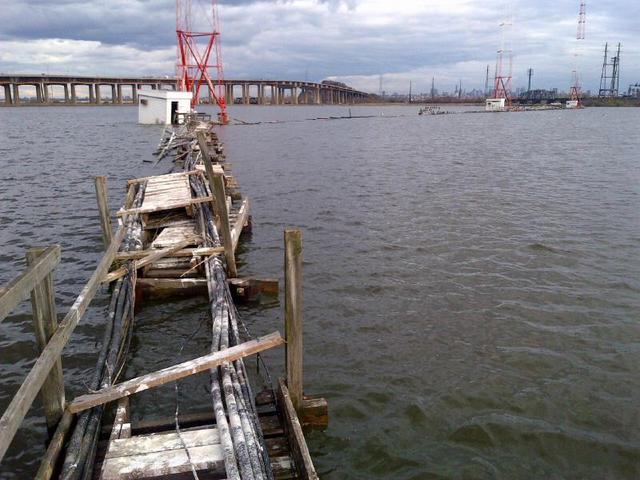
*Across the Hudson, another point of vulnerability became clear in the hours after the storm: record high floodwaters in the New Jersey Meadowlands caused severe damage to many of the AM transmitter sites that are tightly clustered there. In addition to knocking CBS Radio’s all-news WINS (1010) off the air for several days, the storm caused even more severe damage across Polito Avenue at the Lyndhurst site of WLIB (1190), which remains silent, and a few miles south in Kearny at the site shared by Salem’s WMCA (570) and public radio WNYC (820). For the first time anyone can remember in that site’s nearly 70-year history, water rose into the transmitter building, severely damaging both stations’ transmitters as well as ripping apart the boardwalk and transmission lines that led out into the water where the stations’ three-tower array sits.
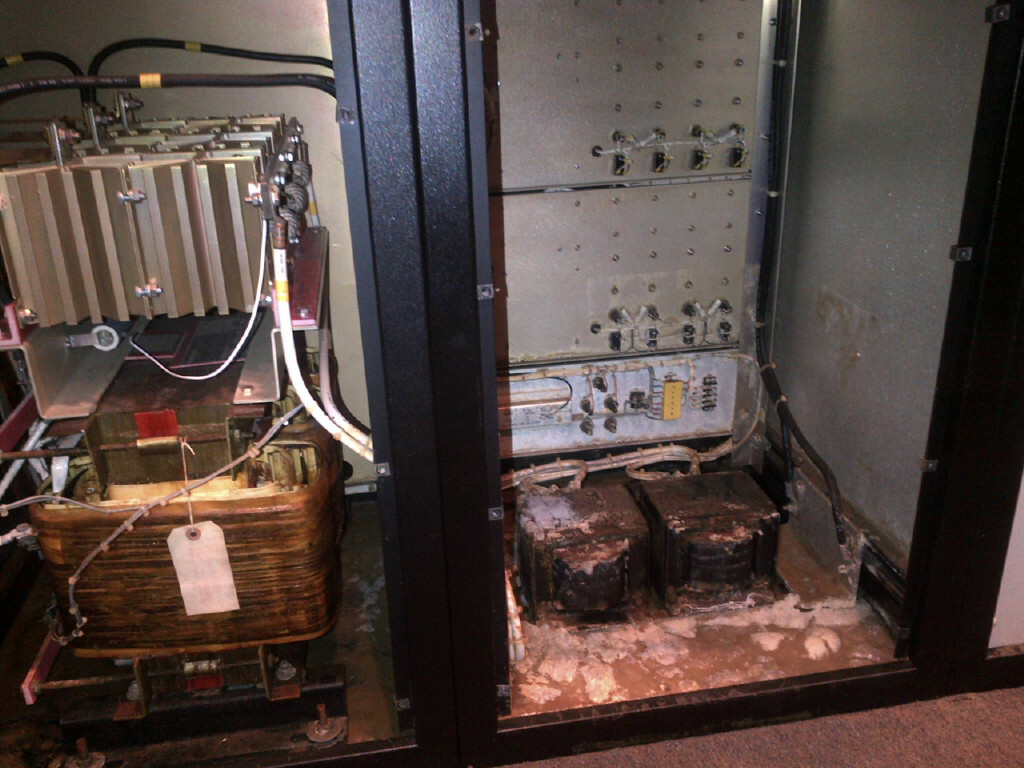
WMCA remains off the air as Salem engineers from around the country attempt to rebuild the site; WNYC came back on the air late Friday with a temporary 1 kW transmitter running non-directionally into a single tower. There’s word that a temporary transmission line will be installed to diplex both WMCA and WNYC while the walkway and permanent transmission lines are rebuilt.
Also still silent is independent freeform station WFMU (91.1 East Orange), which suffered water damage to its studios in Jersey City (where a makeshift streaming operation is now up and running) and to both its main WFMU transmitter on First Mountain and to its Catskills relay, WMFU (90.1 Mount Hope NY). WFMU cancelled its big “Record Fair” fundraiser this past weekend because of power problems making the venue unusable, and it won’t be able to reschedule this year’s event.
Public jazz station WBGO (88.3 Newark) was also forced out of its studios by the storm; there’s word that it spent some time broadcasting from a staffer’s basement until power could be restored.
Down the shore, everything’s decidedly not all right. The rebuilding of the shore towns, and especially along the barrier islands, will be a long process, and broadcasters were affected by the damage, too. New Jersey Public Radio’s WNJO (90.3 Toms River) simply no longer exists: its transmitter site just north of Seaside Heights was washed somewhere out to sea when the winds and rain hit, and for now the area remains largely inaccessible to even begin thinking about rebuilding. We’re still awaiting word on the fate of some of the other sites poised closest to the shore damage; we know transmitters were destroyed at WOND (1400 Pleasantville), among others.
*There was also storm damage in more distant areas: power outages in Rhode Island knocked out signals there when the storm hit, sending Rhode Island NPR’s WELH (88.1 Providence) to a low-power backup at its studios and to a temporary simulcast on Providence College’s WDOM (91.3), and in South County the signal is still out at WRIU (90.3 Kingston).
The Lehigh Valley was also affected, knocking out power to Clear Channel’s Allentown cluster, among others, for several days.
We’ll keep following the storm damage and recovery in the weeks to come here at NERW; please check in with your report, if you haven’t had a chance to do so yet!
 *The week’s other big New York City story happened Thursday night at 11:57, when Merlin signed off rocker WRXP (101.9), handing over the signal to CBS Radio in a $75 million deal that resulted, seconds later, in the launch of WFAN-FM, the city’s second FM sports station after ESPN’s WEPN-FM (98.7).
WFAN paid tribute to its original AM launch back in 1987 by using the same voice to launch its FM signal. Suzyn Waldman was a sports update anchor back then; now she’s John Sterling’s partner on Yankees broadcasts over at CBS sister station WCBS (880), and of course the WFAN move to FM reignites speculation that CBS will be making a bid before long to move the Yankees over to the new WFAN-FM.
For now, CBS is making good on its vow to keep a full simulcast going between WFAN’s established AM signal at 660 and its new 101.9 FM signal; it’s still widely expected that CBS will put its new national CBS Sports Radio network on 660 once it launches in January, making the local WFAN programming FM-only.
(Listeners with HD Radio receivers found some changes as a result of WFAN’s FM move – gone is WXRK’s 92.3-HD3, which had been simulcasting WFAN, freeing up bandwidth to allow for stereo on “K-Rock 2” on 92.3-HD2. There’s no HD at the moment on 101.9, which had been running smooth jazz on its HD2.)
*In Syracuse, Galaxy’s WZUN (102.1 Phoenix) is traditionally one of the first stations in the country to go all-Christmas, and 2012 is no exception: WZUN made the flip right on schedule last Thursday. This year, sister station WUMX (102.5) in Utica is holding back, waiting a few weeks to make its own flip. (Meanwhile, Galaxy has won the early rounds of its legal fight with Cumulus to keep the former WAQX morning team of Hunter Scott and Josh Grosvent on its WKRL/WKRH/WKLL; while a judge ruled that the duo can’t use one of its signature characters or refer to their show as “The Show,” two courts have now denied Cumulus’ bid for an injunction to keep Hunter and Josh off the air at Galaxy. The next court date in the case is November 21 in Syracuse.)

CNYRadio.com reports that a Utica television veteran is getting ready to sign off. Bill Worden started his broadcast career almost fifty years ago at Utica’s WBVM (1550, now WUSP) and WRUN (1150, now WUTI), later working in TV in Wichita and Columbus before returning to Utica in 1977 to become 6 and 11 PM anchor at WKTV (Channel 2). Worden has been there ever since, also anchoring WKTV’s 10 PM CW newscast and serving for a time as news director. Worden announced last week that after his November 29 newscast, he’s leaving TV and pursuing his other passion, music: he’s joined the Mark Bolos Band as a percussionist.
Don Shipman will move from WKTV’s morning newscasts to anchor the 5, 10 and 11 PM broadcasts; sports director Jason Powles will move to mornings; and weekend sports anchor Mike Levin will take over as sports director. Station manager/news director Steve McMurray, who now co-anchors the 5 PM show, will move to the 6 PM anchor slot alongside Kristen Copeland, who also anchors at 5.
*There’s a translator swap underway in Buffalo: Family Life Ministries is trading W201BE (88.1 Buffalo) to Delaware-based Priority Radio, which will use the signal to relay its “Reach FM” WXHL-FM (89.1 Christiana DE). In exchange, Family Life will get Priority’s W207BB (89.3 Buffalo, displaced by Family Life’s new WCOM 89.3 Silver Creek), as well as a translator in Ashtabula, Ohio to extend its westward reach from the Erie, Pennsylvania area.
*Looking for more syndicated content on your morning radio dial? Look no farther than central PENNSYLVANIA, where more wakeup hours are now being filled by content from Michigan and Ohio. The Michigan component comes from Hall’s WKZF (92.7 Starview), which brought the Grand Rapids-based “Free Beer and Hot Wings” show to the Harrisburg/York area in late October. As for Ohio, that’s the “Dave and Jimmy Morning Show,” which originates at WNCI in Columbus and has just been added to Clear Channel’s WVRT (97.7)/WVRZ (99.7) in the Williamsport market, replacing local operations manager Eric White in that slot. (Dave and Jimmy are also heard in the region on Clear Channel sister station WHKF in Harrisburg.)
In the midst of the storm, one long-silent AM signal actually returned to the air: WPAM (1450 Pottsville) had been entirely silent since April, and technical issues had taken the classic rock station on and off the air as far back as November 2011.
Our unexpected trip through central Pennsylvania late last week reminded us that a new signal had signed on this summer at the northern end of the US 15 corridor: WTIO (88.3 Mainesburg) runs just 48 watts/848′, but it brings the NPR programming of Scranton’s WVIA (89.9) to an area around Mansfield and Troy where public radio reception is shaky at best. (The calls stand for “TIOga County, where the station is located.)
And we note with sadness the passing of longtime Susquehanna Radio top executive Art Carlson, who presided over the company’s expansion from its original base in central Pennsylvania at WSBA in York and WARM in Scranton into a much bigger footprint beyond the region. Carlson had started with Susquehanna at WARM in 1958, and retired from the company as its president in 1994. He died Saturday (Nov. 3) in Jacksonville, Florida at age 82.
*On the CONNECTICUT-New York line, Marshall Miles’ Tri-State Public Communications is making good on its name. WHDD-FM (91.9 Sharon)/WHDD (1020 Sharon) already expanded north into the Berkshires with a western Massachusetts simulcast on WBSL (91.7 Sheffield), and now WHDD’s “Robin Hood Radio” programming is being heard in more of the Hudson Valley via Bard College’s WLHV (88.1 Annandale-on-Hudson), which began test transmissions last week at half-power. When it reaches its full 910-watt licensed power, WLHV will reach Kingston and Rhinebeck with a usable signal, adding about 150,000 potential listeners to the WHDD audience.
*After WIHS (104.9 Middletown) complained about interference from a co-channel translator in Bridgeport, the translator is filing to change channels. Red Wolf Broadcasting applied last week to move W285DE from 104.9 to 104.5, where it will continue translating the “La Bomba” Spanish-language HD subchannel of co-owned WMRQ (104.1 Waterbury). The translator will still run 250 watts at its new location on the dial.

*In eastern MASSACHUSETTS, Entercom’s WRKO (680 Boston) is shuffling its morning lineup yet again. Out, at least for now, are Michele McPhee (who’s bounced around from WRKO to WTKK and back again) and veteran WRKO talker Todd Feinburg; in as the new morning man is Washington-based Jeff Kuhner, who’s been a regular fill-in host on WRKO in recent months. It’s not yet clear whether Kuhner will continue to broadcast from Washington, or whether he’ll move his show up to Boston. WRKO also says it will find a new role for Feinburg at some point soon. (Kuhner continues hosting the 11 AM-noon hour on WRKO for now, as well.)
Cape Cod broadcaster John Garabedian is adding a fourth signal to his new “Codcomm” group, paying David and Deborah Wang’s Liveair Communications $90,000 for the construction permit for a class A signal at 98.7 in East Harwich. Liveair won the frequency at auction for $55,000 (less a bidding credit) last year. Under Codcomm, the new 98.7 has already requested the calls “WKFY”; it will join Codcomm’s existing WPXC (102.9 Hyannis), WFRQ (93.5 Harwich Port) and WHYA (101.1 Mashpee) once the sale is complete.
There’s a new FM signal on the air in the Fitchburg area. Owned by “Prayers for Life, Inc.,” WQPH (89.3 Shirley) is following the traditional pattern of Catholic radio launches, signing on as a 24-hour relay of the national EWTN Radio service but promising to add local programming eventually from its studios at the Madonna of the Holy Rosary Evangelization Center.
*Go as far north as you can go in VERMONT and you find yourself looking at a radio station painted like a spotted cow. That’s WIKE (1490 Newport) and WMOO-FM (92.1 Derby Line), and it’s about to have another new owner. WIKE/WMOO had ended up as part of Nassau’s massive northern New England holdings, and Nassau’s bankruptcy auction then sent those signals to Jeff Shapiro’s Vertical Capital Partners. Now he’s turning around and selling the stations to another big owner in the region, Bruce James’ Vermont Broadcast Associates. James’ cluster in the Northeast Kingdom already includes WSTJ (1340 St. Johnsbury), WGMT (97.7 Lyndon), WKHX (105.5 St. Johnsbury) and WMTK (106.3 Littleton NH); he’s spinning WQJQ (100.3 Barton) to Capital Broadcasting Associates for $25,000.
In Brattleboro, they’re mourning the co-founder of community station WVEW-LP (107.7). Larry Bloch was an entrepreneur-turned-social activist known for his involvement in building the “jam band” music scene in the 1990s, when he owned the influential Wetlands nightclub in New York. In 1996, Bloch sold the club and moved to Vermont, where he became involved in putting the unlicensed Radio Free Brattleboro on the air. Many of the RFB staff moved over to WVEW when it launched in 2006, and Bloch became WVEW’s program director. He died October 28 of pancreatic cancer, at just 59 years old.
*From NEW HAMPSHIRE comes word that Chris “Doc” Garrett, recently sent packing after 20 years with Clear Channel’s WGIR-FM (101.1 Manchester)/WHEB (100.3 Portsmouth), has landed with Bill Binnie’s new broadcast group as general manager of WFNQ (106.3 Nashua).
*Is longtime AM radio advocate Bob Bittner adding (gasp!) an FM signal in MAINE? It sure looks that way – his Blue Jey Broadcasting is paying $100,000 to Light of Life Ministries for translator W252BT (98.3 Freeport), which will flip from relaying WWWA (95.3 Winslow) to Bittner’s WJTO (730 Bath).
(And we note, as a matter of history, that before his WJIB/WJTO years, Bittner’s earlier career was very FM-centric, spent here in Rochester at two pioneering independent FMs, WCMF 96.5 and WVOR 100.5.)
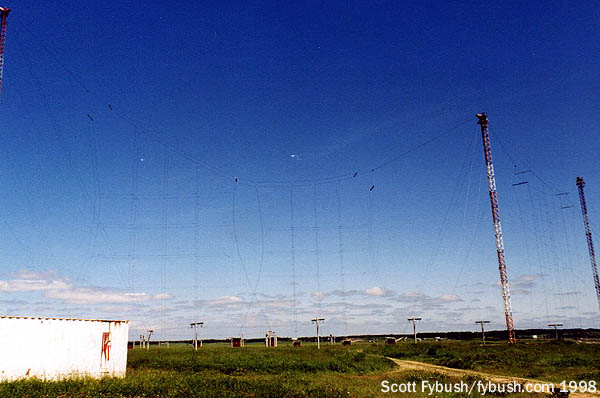
*As of last Thursday, the CBC no longer holds a license for its Radio CANADA International shortwave transmitters at Sackville, New Brunswick. At RCI’s request, the CRTC revoked the license, which held the (never-announced) callsign CKCX. Most transmissions from Sackville ceased earlier in October, and RCI engineers have reportedly begun dismantling the massive antenna arrays after the CBC failed to find a buyer for the facility.
The last remaining transmission from Sackville is the CBC’s Northern Quebec Service, operating on 9625 kHz and aimed northwest at the remote native villages that dot the frigid landscape up there. The CBC is in the process of building out a network of small FM signals to replace the shortwave service, but in the meantime it appears “CKCX” will remain on the air a while longer, even without an official license, in order to serve northern Quebec.
*The CBC is also in the process of completing a facility change in Windsor, Ontario, where the transmitter site for its Radio-Canada service, CBEF (540), was reportedly in need of expensive repairs. Instead of fixing up that site, the CBC asked the CRTC if it could move the CBEF license to the facility on 1550 last used by its English-language service, CBE. That service has moved to FM (as CBEW 97.5), but the old 1550 transmission facility was in decent repair – and so as of last week, CBEF is being heard transitionally both on 540 and 1550 before the 540 signal is silenced for good.
*In London, Sound of Faith Broadcasting’s CHJX has a new frequency – it recently moved from 10 watts on 105.9 to 500 watts on 99.9 – and now it has a new identity, too. Dan Sys’ Canadian Radio News reports CHJX has flipped from “Inspire FM” to “Faith FM.”
[/private]
 *Good news, everybody! A new shipment of the 2013 Tower Site Calendar is back from the printer, and on its way out to YOU!
This is the 12th edition of our annual calendar, which features photos of broadcast towers taken by Scott Fybush on his travels.
The 12-month wall calendar boasts a full-color photo each month of a well-known broadcast transmitter site.
This year’s edition includes sites in Florida, Wisconsin, Kentucky, California, Iowa, Idaho, Las Vegas, Colorado, Boston, Cleveland, Albuquerque, upstate New York and western Massachusetts. We’ve also redesigned the calendar to make it more colorful (don’t worry; the pictures are still pristine) and make the spiral binding our standard binding — your calendar will hang even better on your wall now! And of course, we still have the convenient hole for hanging.
Order 20 or more for a 10% discount! And while you’re at the Fybush.com store, check out the new National Radio Club AM Log and the final stash of FM Atlas editions.
For more information and to order yours, click here!
From the NERW Archives
Yup, we’ve been doing this a long time now, and so we’re digging back into the vaults for a look at what NERW was covering one, five, ten and – where available – fifteen years ago this week, or thereabouts. Note that the column appeared on an erratic schedule in its earliest years as “New England Radio Watch,” and didn’t go to a regular weekly schedule until 1997. One Year Ago: November 7, 2011 – *Welcome to our new home! There aren’t many websites that have lasted more than a decade without a redesign, and with this week’s NERW we retire the old version of fybush.com, designed and built by your editor (in PageMill 3.0!) way back in 2000 and slightly modified in early 2001. Our new WordPress-based look comes to you with the assistance of Dustin McShane and MindSwell Media, and over the next few days we’ll have the new site fully up and running. Enough about what’s happening behind the scenes: on with this week’s column:
Last photo of the old towers, Saturday afternoon *We start in western MASSACHUSETTS, where the end came quietly Saturday afternoon for a venerable radio landmark. Longtime NERW readers knew that the original WBZ towers atop the old Westinghouse plant on Page Boulevard in East Springfield were doomed to demolition as part of the site’s redevelopment for retail use. But until the very end of last week, we didn’t know exactly when the towers would be coming down. As it turned out, the old towers – the very pieces of steel that supported the antenna from which WBZ first broadcast 90 years ago this fall – enjoyed one last moment on the air just hours before crews pulled them down. Engineer Kurt Jackson, who was contracted to remove the towers, arranged for a special-event license from the FCC to operate an amateur radio station from a longwire antenna at the site on Saturday, and for just a few hours station “W1Z” operated on shortwave from a temporary operating station inside the WBZ “mobile newsroom” parked next to the gutted shell of the Westinghouse building. Once W1Z had signed off, the rest happened quickly: crews climbed the building, cut the towers at their bases, and quickly pulled them down. While some pieces were salvaged as souvenirs, it’s still an unfortunate end to a very important piece of technology history. The WBZ site in East Springfield was, as best we can tell, a unique survivor of the earliest era of AM tower sites, having long outlived other rooftop longwires of its era. (For instance, the towers used for the original KDKA installation in East Pittsburgh have been gone for decades, and the building itself met the wrecking ball just after the turn of the century; other early AM sites such as the Westinghouse plant and WOR/Bamberger plant in Newark are also long gone.)
90 years of history, toppled With WBZ’s first home now gone as well, only a handful of 1920s AM sites survive, none in anything close to their original form. The 1924 transmitter building for WCCO in Minneapolis still stands, used for storage a few hundred yards from the newer 1930s-era building and tower now used by the station. In Mason, Ohio, the 1927 transmitter building for WLW remains (and will be featured later this week on Tower Site of the Week), as does an even earlier structure next door that was an early transmitter building for sister station WSAI. But most of the towers from that era succumbed quickly to technological progress: when modern vertical AM antennas replaced the longwires beginning in the early 1930s, the old antennas weren’t kept around, for the most part. WBZ’s Springfield site survived as long as it did because of two accidents of historical inertia: first, the move of WBZ’s main studio and transmitter to the Boston area in 1931 left the Springfield facility (renamed “WBZA”) behind as something of an afterthought, with Westinghouse investing as little as possible in updating the Springfield site over the ensuing 31 years. And after WBZA signed off from Springfield for good in 1962, Westinghouse never bothered to spend the money to remove the old towers, which then remained in place as the old Westinghouse facility moldered after the company moved out. As we write this on Sunday night, much of Connecticut is just getting power restored after a week without service. The storm silenced many smaller stations around the state, and some bigger ones, too: downed trees along the access road to the West Peak FM tower site in Meriden kept engineers from accessing the stations there, and Buckley’s WDRC-FM (102.9) was especially hard-hit when its generator failed and nobody could get to the site to fix it. *The week’s other big Connecticut story comes from the Fairfield County shoreline, where Cox Radio is exiting the AM business with the sale of WNLK (1350 Norwalk) and WSTC (1400 Stamford) to Sacred Heart University’s public broadcaster, WSHU. The sale price hasn’t yet been disclosed, but it’s believed to be significantly less than Cox paid to acquire the AM signals (along with their sister FMs, one of which – WFOX-FM 95.9 – remains in the Cox fold, while another – now WKLV 96.7 – has also been sold off.)
As for WSHU, in addition to its primary news-and-music format on WSHU-FM (91.1 Fairfield), the public broadcaster now dominates the upper end of the AM dial in the region: in addition to WNLK and WSTC, which it began operating under an LMA Sunday night, it owns WSHU (1260 Westport) and operates WYBC (1340 New Haven). For now, at least, it appears that WNLK and WSTC will mostly simulcast the NPR news-talk programming already heard on WSHU(AM), though they’ll break away on Sundays from 10 AM-2 PM to continue carrying La Barca’s “Italian House Party,” a long-running fixture of Fairfield County radio. *And WSHU isn’t the only Connecticut public broadcaster extending its reach: Hartford-based WNPR Connecticut Public Radio has signed a deal to place its programming on WAIC (91.9 Springfield MA), replacing student programming at the American International College station, which had most recently been running an adult hits format as “91.9 the Buzz.” In NEW YORK, WABC (770) program director Laurie Cantillo exited last week after less than three years on the job. While Cantillo was a well-liked figure at Two Penn Plaza, her tenure was marked from the beginning with questions about the purpose of the job, given the WABC program lineup that’s now almost entirely made up of syndicated shows. But Cantillo at least made a valiant effort to localize the schedule as much as possible, launching the local late-morning Joe Crummey show last year as well as several weekend offerings. The most recent round of Cumulus cutbacks stripped WABC of several local staffers, and it’s not entirely surprising to find Cantillo moving on, evidently of her own accord. (The rumor mill is already suggesting that Cantillo’s next stop might be at struggling all-newser WEMP.) Moving upstate, Don Crawford Jr.’s DJRA group will pull the plug on the “Legends” oldies format Friday at Albany-market WPTR (96.7 Clifton Park). Crawford, whose father still owns sister station WDCD (1540 Albany), tells listeners that he faced “very weighty financial demands” from the company’s lenders, and that’s why the station will flip formats later this week, apparently back to the contemporary Christian format it had been running before “Legends” launched in February. Unlike its Rochester sister station WLGZ (102.7), which has used a stable of live and local jocks to achieve decent ratings, the Albany “Legends” depended on voicetracks from those Rochester jocks (and others), and a limited class A signal kept it from making much of a dent in the Albany ratings. Crawford says WLGZ’s Mark Shuttlesworth will continue to voicetrack a web-only version of the Albany “Legends” after the on-air signal flips on Friday. *On TV, there’s a new owner coming to the Albany market: as we reported in our Wednesday update, Freedom Communications is exiting the TV business, selling its eight-station group to Sinclair for $385 million. The deal includes two stations in NERW-land, both in the Albany market: CBS affiliate WRGB (Channel 6) and CW affiliate WCWN (Channel 45). The new stations fit nicely with an existing Sinclair footprint in the region that includes stations in Buffalo, Rochester, Syracuse and Portland, Maine. Sinclair takes over right away under an LMA, and hopes to close on the sale in early 2012. *And of course we can’t move on from New York without noting the death on Friday of Andy Rooney. While the Albany native and Colgate University graduate never worked in local broadcasting (he moved from local newspapers to World War II reporting right into network radio and then TV), his long network service qualifies him for NERW mention – as do his offspring: daughter Emily, of course, was news director at WCVB-TV and now hosts “Greater Boston” on WGBH radio and television, while son Brian started his local TV career at Rochester’s WOKR (now WHAM-TV) and then worked at WPRI in Providence before moving on to WBBM-TV in Chicago and then ABC News. Rooney was 92; his death followed complications from what was reported to have been a “minor” surgical procedure, just a few weeks after his final commentary aired on “60 Minutes.” Five Years Ago: November 5, 2007 – *Is it still news when we’ve known it was coming for weeks? That’s where things stand with the latest headlines from NEW YORK, where Citadel’s WABC (770) sent morning co-host Ron Kuby packing after Thursday morning’s “Curtis and Kuby” show, following that a few hours later with the long-awaited official announcement that Don Imus would be coming to WABC’s morning drive on December 3. The new show will be syndicated by ABC Radio Networks, and the big speculation now revolves around where Imus might land in some of the other markets where he used to be heard. Will WTKK in Boston, which has been trying without success to break Howie Carr’s WRKO contract (and which lost another round in court last week), fall back on its former morning man? (Or will WRKO, which is struggling with the Tom Finneran morning disaster, cut its losses and go with the proven offering from New York?) Other former Imus markets in the region include Philadelphia, Providence, the New Hampshire seacoast, Manchester, Burlington, Bangor and Portland, and we’ll be watching to see if stations in those areas sign new deals to carry the revived Imus show. Back in New York, Kuby was unhappy about his abrupt dismissal – and vocal about it, too, taking to the airwaves at rival stations to complain about the irony that he, a civil rights lawyer, was losing his job so that Imus could return from unemployment. As for Kuby’s co-host, Curtis Sliwa, Citadel says it intends to keep him on WABC, perhaps sharing the late-morning slot with John R. Gambling – but the rumor mill was aflutter last weekend with speculation that Sliwa might instead head downtown to Buckley’s WOR (710), perhaps re-teaming with Kuby there in morning drive. *At the other end of the state, Holy Family Communication’s WHIC (1460 Rochester) dedicated its new transmitter site Tuesday morning, interrupting its usual Catholic programming for a special live broadcast from the site hosted by general manager (and Rochester radio veteran) Jack Palvino, and featuring a blessing from Rochester’s Bishop Matthew Clark, who said he’s never blessed a radio tower before. Holy Family also saluted the town of Henrietta for its quick approval of the new site, a rare feat in this day of rampant NIMBY-ism, and one made easier by the site’s location in an industrial area with few neighbors to complain. The site’s not quite finished yet – the new phasor had just been delivered last week, and the antenna tuning units and ground system weren’t yet complete – but WHIC expects to be on the air from the new site before the end of autumn. Regent Communications continued the selloff of some of its non-core stations last week, following the sale of its lone Albany AM (WTMM 1300 Rensselaer) with the sale of its lone AM in the Buffalo market. Dick Greene’s Culver Communications will pay Regent $1.3 million for WECK (1230 Cheektowaga), which has been doing automated classic country as a flanker to Regent’s big WYRK (106.5 Buffalo). Culver already owns WLVL (1340 Lockport), and the WECK acquisition will help Greene expand his reach southward from Niagara County into Erie County. John Pierce & Co. brokered the deal for Regent, with Dick Kozacko representing Greene. *October was a month of frequency upgrades in PENNSYLVANIA. On October 17, the venerable religious outlet WPEL (1250 Montrose) switched off that frequency after more than half a century, moving its 1000-watt daytime signal down the dial to 800 kHz, where that kilowatt will carry further. WPEL(AM) runs a southern gospel format, while its sister station WPEL-FM (96.5) serves both Scranton/Wilkes-Barre and Binghamton with a religious teaching format.
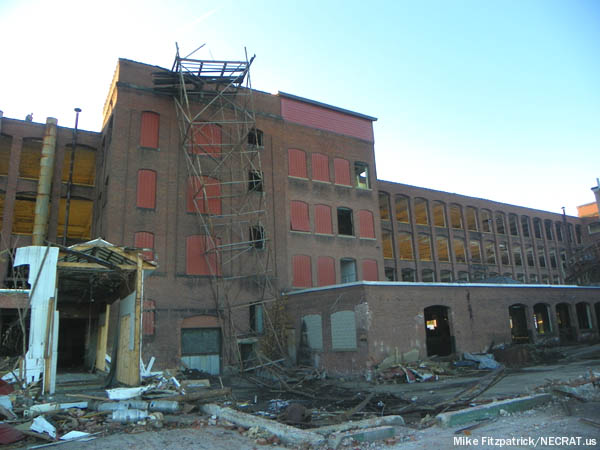
88.7 now has the WXPH calls, and as of Nov. 1, it’s relaying WXPN’s AAA format to a wider region that now includes York and Lancaster as well as Harrisburg. As for 88.1, it’s now WZXM, carrying “Word FM” religious programming from new owners Four Rivers Community Broadcasting. While we’re in the York area, we say a sad farewell to the longtime transmitter building and former studio home of WSBA (910), which was demolished last week. The old Colonial-style building, which served as WSBA’s studios from 1942 until 1975, stayed in the hands of former owner Susquehanna Pfaltzgraff after the stations were sold to Cumulus, which recently moved the AM transmitter into a new building closer to the towers. That will allow Susquehanna Real Estate, which bought the property two years ago, to develop the land closer to North Susquehanna Trail into an office park. Ten Years Ago: November 11, 2002 – The atmosphere can be a tricky thing sometimes, especially near the coast and especially during the summer. Just ask Boston’s WCVB-DT (Channel 20) and the Camden County, N.J., public safety department, which have been sharing the 506-512 MHz chunk of the UHF spectrum for the last few years. It was never a problem when WCVB-DT was operating a few hours a day, but earlier this year, when the tower work on the Needham tower WCVB shares with WBZ-TV/DT and WGBH/WGBX was completed and WCVB-DT was able to go full-time at full power, officers down in South Jersey started to notice interference to their two-way radio system, which they tracked down to the new DTV signal more than 250 miles to the northeast. Last week the dispute hit the media, with Ocean County (even closer to the coast than Camden County) joining in a complaint to the FCC about interference to their radio systems, which operate in the “T-Band,” first allocated a couple of decades ago on what were then largely unused channels 14-20 in the UHF-TV spectrum. (How unused? So much so that several low UHF TV allocations, such as 14 in Worcester, 16 in Providence and 18 in New Brunswick, N.J., were deleted and reassigned for public safety use.) DTV, of course, changed all that, with every scrap of the UHF TV spectrum being pressed into use during the lengthy transition from analog to digital. In Boston, it’s not just 20; channel 19 is in use by WGBH-DT and channel 18 is allocated for WMFP-DT. In other words, the spectrum that T-band users have had pretty much to themselves is about to get full, and it doesn’t appear that the FCC did its homework when making the allocations there, or in other parts of the DTV spectrum. (Just ask WHRO-DT Norfolk VA and WBOC-TV Salisbury MD, which are battling over channel 16, or WOOD-TV Grand Rapids MI and WMVS-DT Milwaukee, which are fighting over channel 8.) The culprit appears to be the FCC’s modeling mechanism, which does not fully account for the effects of unusual propagation, especially over water. (Notice a common thread in all these DTV disputes?) Any DXer knows that there’s nothing completely predictable about propagation at almost any frequency below 800 MHz (as we type this, we’re watching an E-skip pileup on channel 3 that’s bringing in stations from Memphis, Springfield MO, Harrisburg IL and Eufaula OK, perfectly normal behavior in mid-July but quite unusual in early November), and every reason to think that a 500 MHz signal with a megawatt of power from Boston will often ride the tropospheric ducts down to New Jersey in the summertime. But those are the sort of questions that should have been asked before a license was issued, not after millions of dollars were spent to put up a licensed signal on channel 20 in Boston. How will this all get resolved now that the damage has been done? The good news is that there’s no reason to expect WCVB-DT to remain on channel 20 forever; when the DTV transition is complete, the digital signal will likely replace WCVB’s analog on channel 5. You can read more thoughts on digital transitioning down at the bottom of this week’s column. In the meantime, we’ll be following this closely to see how the FCC gets itself out of the hole it’s dug. (2007 note: WCVB-DT will indeed stay on Channel 20 – we didn’t know back in 2002 how bad low-band VHF would be for digital TV – and the T-band issue has never been fully resolved, as far as we’re aware.) Fifteen Years Ago: November 7, 1997 – The last part of the legendary jock lineup at Boston’s WBCN (104.1) will leave the airwaves after Friday’s show. Mark Parenteau was fired from the CBS-owned modern rocker this week after two decades as BCN’s afternoon-drive host. [Editor’s note: he actually left Thursday.] Parenteau, midday jock Ken Shelton, and morning guy Charles Laquidara were the cornerstones of the WBCN lineup through much of the seventies and eighties. Laquidara was moved to classic rocker WZLX (100.7) two years ago, while Shelton also spent two years at WZLX before being let go from the then-Infinity group in 1995. Replacing Parenteau in the 3-7 slot will be evening jock Nik Carter, a move presumably designed to cater to the younger audience WBCN has sought since shifting to modern rock a few years back. Parenteau kept a promise to present an award at the Achievement in Radio (AIR) awards this week, joking about his dismissal as he went. AIR honorees included WBZ (1030) morning veteran Gary LaPierre, who received the lifetime achievement award; Loren (Owens) and Wally (Brine) of WROR-FM (105.7 Framingham) for best morning show; Nancy Quill of WMJX (106.7) for best midday show; and WBOS (92.9 Brookline)’s Julie Devereaux for best evening show. Elsewhere in MASSACHUSETTS: The FCC has approved the transfer of WNRB (1510 Boston) from Communicom to One-on-One Sports; expect a format change there soon. Cape and Islands Public Radio’s new 90.1 in Woods Hole has been granted the calls WHMV — NERW thinks it’s either a tribute to their favorite record store, or it stands for “Woods Hole and Martha’s Vineyard.” WPZE (1260 Boston) has reverted to a simulcast of WEZE (590) as it awaits the arrival of Radio Disney — “any day now” is the word we’re hearing on that format change. On the pirate front: NERW hears from Mike Malone of the late “WDOA” (89.3 Worcester) that the FCC agents who shut the station down last week told him they were operating under orders from the highest levels of the FCC — new chairman Bill Kennard flexing his muscle, perhaps? Speculation in the pirate community is that the FCC is using pirates’ web pages to find them; could that be why the Rebel Music Radio page has disappeared, while the supposedly-silent Boston pirate at 105.3 was still being heard late last week by at least one NERW reader? And meantime, Cambridge city council candidate Ian McKinnon turned to pirate radio for his campaign, running “Radio Free Cambridge” from a local art gallery during the weekend leading up to Election Day. A confusing (or should that be just plain confused?) article in the Cambridge TAB explained how the station began broadcasting Sunday night…then went on to say “no frequency has been chosen for the station.” Perhaps operating a radio station with no frequency was what doomed McKinnon’s election bid; he drew only 264 votes, falling far behind the nine incumbents, all of whom won re-election without benefit of pirate radio. |

In this week’s issue… AI, virtualization hot topics at NAB - WBAI faces second site eviction - CBS Sports Radio affiliates rebrand - New morning show at Y108 - Remembering Mister Cee
In this week’s issue… Darkness on the edge of NERW-land - WQZS leaves the air - Remembering WBXL's Jenner, Stern's "Crazy Cabbie," Pittsburgh's O'Brien
In this week’s issue… Alhart sets end date - WNBC's Scarborough hits 50 - Garabedian relaunches WJIB - Rogers rebrands in Toronto - One less "Nash" in PA - Albany meets "Zoey"
In this week’s issue… FCC cracks down on Nexstar's WPIX deal - Remembering WBZ's Shaw - More new LPFMs all over