NorthEast Radio Watch 3/16/2026: Ernie Anastos Dies
In this week’s issue… Hall sells WCTK, WNBH - Remembering NY's Anastos - WMEX sale withdrawn - Saga moves in western Mass - TikTok Radio launches on iHeart subs

In this week’s issue… CPB funding cuts, Colbert cancellation roil media waters – Maine AM to sign off – WNYC CEO’s new role – WLIR seeks boosters – More site static for NJ, Canada AMs – Remembering Philly’s Pasternak, Finger Lakes’ Cotterill
By SCOTT FYBUSH
*Your editor was on vacation last week, out with the family visiting presidential history sites, railroad museums, tower sites and, yes, the World’s Largest Ball of Paint all across the midwest.
The news of the media world, however, was churning viciously all week while the NERW-mobile was on the road, and you already know the news items that were blowing up our phone all week: the recission of federal funding to the Corporation for Public Broadcasting, which was no surprise, and the announcement that CBS will be cancelling the “Late Show with Stephen Colbert” when his contract is up next year.
 If you’re a longtime NERW reader, you won’t be surprised to know we have some strong opinions on both matters and on the new, strained relationship between broadcasters and a government that’s suddenly much less hands-off than it used to be. (And if you’re not interested in our opinion and you’re a subscriber, just skip over the next few paragraphs and you’ll find the rest of the week’s news, such as it was.)
Still with us? Back in February in this space, we issued an unusually strong warning about the dangers of destabilizing broadcast regulation and about creeping authoritarianism in Washington. Almost six months later, there’s nothing we warned about that hasn’t come to pass – and if anything, the relentless dismantling of institution and structure in the federal government and all the parts of our lives that it touches has been even swifter than we expected, with even less pushback.
Let’s start with public media: as someone who’s worked in that space for more than 20 years (currently as a consultant and broker, having left the newsroom last year), your editor is full of criticism of the many ways in which that system isn’t working as well as it could or should.
We recognize the libertarian argument that says there shouldn’t be any public media system with even a dollar of public funding, and if you have that as your starting point, there’s probably not much else we’re going to agree on. For all of its many flaws, there’s a lot that public media is delivering to audiences that simply doesn’t exist anywhere else on the broadcasting landscape or even on the infinite dial of streaming.
In the entire region we cover, if you’re looking for classical music or jazz, it’s only public radio that’s delivering those formats (with a couple of tiny commercial exceptions in southern New England for classical). Live in rural Vermont, northern Maine, New York’s Adirondacks or central Pennsylvania and you want to hear some news and documentary voices about your region and what’s happening in your state capital? Stations such as Vermont Public, Maine Public, North Country Public Radio and WITF are out there every day doing what commercial media long ago mostly abandoned, providing daily news that goes deeper than brief headlines and celebrating the sounds and ideas of their sprawling broadcast areas.
While some of what public TV does has indeed been augmented or even replaced by everything that’s available on streaming, we reject the argument that it’s made PBS obsolete. Documentaries and cultural offerings are all over YouTube and Vimeo, sure – but those of us who’ve toiled in the trenches for decades understand that really good production often takes budgets that are a lot larger than your average YouTuber can muster, which is why there’s very little out there commercially that can match the quality and consistency of “Nova,” “Great Performances” or “American Experience,” the last of which has already announced the suspension of new production.
You’ve been hearing these arguments very loudly ever since the threat to CPB funding became so real a few months ago, we know. We hear from some commercial broadcasters who see public media as an enemy to be vanquished, a competitor funded by their very own tax dollars (an entire couple of dollars or so per person across the country every year.)
We think that’s unfortunate, and here’s why.
Over more than a century in most parts of the world, there’s been an understanding, sometimes hard-learned, that there’s a place on a healthy broadcast dial for both unfettered mass-market commercial media and for a public broadcasting system that does the things commercial broadcasters can’t or won’t do. We see it in Canada, where the CBC and commercial media have co-existed, sometimes uncomfortably, for almost the entire history of radio and TV. In Europe and parts of Asia, public media systems are very much state-run and funded at much higher levels than over here, offering news and cultural services that are larger and more comprehensive than anything the systems in the US can provide.
What happens in those situations? As broadcasting fights for its place in an expanded media world, the diversity that public media brings to radio and TV allows the industry to retain a sometimes very large group of listeners and viewers who would otherwise find little or nothing of value to them from commercial media. If you’re a WNYC listener in New York and you spend your day enveloped in the local conversations that Brian Lehrer and Alison Stewart conduct, or with the classical music of WQXR, where are you going if they go away suddenly? Certainly not to the very different flavors of talk on WABC or WOR, or to the mass-market music of Z100 or CBS-FM.
When those public radio listeners count in the ratings, they count not only “against” the commercial stations, but in a sense with them, too, because those public radio audiences add in to the overall “people using radio” numbers that commercial broadcasters depend on to, you know, sell advertising.
“Okay then,” goes the argument, “if that programming is so good, why don’t they sell commercials, or get listeners to make up the difference?”
 For the stations that hold non-commercial licenses, of course, they simply can’t sell ads. If anything, Brendan Carr’s FCC has made it clear that one of the avenues it’s pursuing next is to put even greater scrutiny on the language non-commercial stations can use in underwriting announcement. For stations in sparsely-populated areas like northern New York or rural Maine and New Hampshire, there’s just not the volume or the economy to make full listener support viable for the sort of local flavor NCPR or NHPR provide to their areas.
And that is why the speedy push toward recission of the CPB’s immediate funding is so problematic on so many levels that should also concern commercial broadcasters. A more thoughtful, studied approach toward fixing the flaws in our public media system could have produced rational improvements to real problems.
For example, too many public broadcasters are indeed operating as small fiefdoms carrying unsustainably large management payrolls. Anyone who’s actually studied the history of public broadcasting since it was created in its current form understands that that’s largely a result of the deliberate decentralization of the system back when it was designed. The commercial networks of the time didn’t want a public broadcasting network competing with them head-on; they wanted a system that was devolved to local levels of control.
That’s why we ended up with this somewhat bizarre system where federal funds don’t go directly to stations (or to NPR or PBS) but rather are funnelled through what’s supposed to be a somewhat independent CPB. It’s a system that was probably ripe for some study and reform to figure out what’s working, what isn’t working, which stations have the most need for CPB money and which can largely sustain themselves in other ways.
There’s no question, as Lance Venta said last week in his RadioInsight commentary, that many public broadcasters have been slow to find ways to adapt to today’s broadcasting landscape. The sudden rug pull of CPB funding will force many of them to do what they should have already been doing. So many of the things each station does individually, whether it’s membership drive and management, traffic scheduling, engineering services and other back-end functions, can and should be combined for better efficiency.
But there’s a right way and a wrong way to do that, and what happened last week is the wrong way.
Remember what we said back in February about the importance of stability? Ever since CPB was created back in the 1960s, it’s been funded two years out, and that’s not by accident. In addition to trying to prevent exactly the kind of politically motivated maneuver that the recission represents, that advance funding provides certainty to station managers who are already being hammered by so many obstacles right now.
Instead of an immediate rescission, a thoughtful Congress could have worked through the usual funding process and provided public broadcasters with a smoother transition to a future without CPB funding, if that had really been the goal, which it wasn’t.
Consider, if you will, the unsubtle tweet that New York’s Elise Stefanik put out after the rescission vote:
“Goodbye, @npr and @ncpr!”
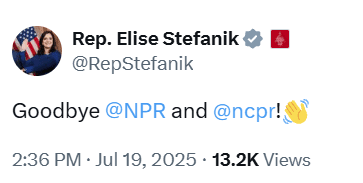 Stefanik, a Republican who represents most of NCPR’s coverage area, came in for some well-deserved criticism after that, but her tweet reflects at least some of the mentality behind the vote from the faction that has no interest in any of the subtleties of the system they’re openly trying to get rid of completely.
To which we can only say, be careful what you wish for.
While most public broadcasters are implementing budget and staffing cuts in reaction to the rescission vote, it’s clear that they’re not about to wither up and die. Instead, they’re seeing increases in member giving (at least in the short term) and rallying support for the programming that commercial competitors don’t provide.
NPR itself, which of course owns no stations and receives no direct funding from the CPB, is already working with its member stations to make sure that the most vulnerable ones get a break in membership fees if they need one to survive.
And if stations do begin to fail? That’s not something thoughtful commercial broadcasters should want. It’s not going to magically transform public radio listeners and public TV viewers into consumers of local commercial broadcasting; instead, it’s just going to shrink the overall “people using radio” universe in ways that will end up negatively affecting commercial stations.
In the worlds of broadcast equipment and software and consulting engineering, a shrinking or dead public media landscape certainly won’t do commercial broadcasters any favors, either. It’s been quite a few years since any CPB grant money was allocated for equipment and new signals for public broadcasters, but as nonprofit organizations, those broadcasters are still obligated to plow net revenues back into operations, which means a lot of non-CPB money has been spent over the years on consoles and transmitters.
Reduce public broadcasters’ budgets at a time when so many broadcast vendors are already on shaky ground from tariffs and overall economic uncertainty? Some vendors will fail, development of new technologies will slow down, and whoever survives will be stretched thinner as they try to survive in a much smaller broadcasting landscape. Looking for an engineer in your market? There’s a good chance that your local public broadcaster is having a hand in training new engineers, hosting SBE meetings and developing new talent. If your public broadcaster goes away, who takes over that responsibility in your market?
(For that matter, a not-insignificant part of our paid readership here comes from people who work in public media. If they lose their jobs and can’t afford a NERW subscription and our readership base drops even lower, that could be the straw that finally leads to the end of this column after 31 years.)
Is that healthy for commercial broadcasters? Very likely not – but the rescission voters never took that into consideration, did they?
If the law somehow gets changed to allow public broadcasters to sell full-fledged commercials? That’s something else that commercial broadcasters probably shouldn’t want to see happen after a little bit of thought. Barred from selling full-fledged ads that include calls to action, prices and jingles, public radio (and TV) was designed so it couldn’t become a full competitor for commercial media’s shrinking ad dollars. Remove those restrictions and now you’ve got broadcasters who often have more local content and local presence than many commercial broadcasters, all freed to do whatever it takes to go after the car dealers and law firms and drug companies that until now have had to use commercial radio and TV to make the hard sell for their products.
And if forced to compete commercially, it’s inevitable that the programming on public TV and radio will change in ways that will more directly target commercial operators. The system that’s existed for decades now has suspended public broadcasters in something of a halfway state: their programming has to serve a somewhat sizable audience in order to attract member support and underwriters (and in fact CPB requires minimum audience sizes in order to provide funding), but it also has a mission-driven charge to provide alternatives to whatever’s on offer from commercial competitors, albeit without the complete freedom that true state-run public broadcasters can enjoy to shun commercial concerns and serve the niches. Take away that guardrail, give public broadcasters the incentive to chase the lower common denominator, and… well, that’s something else that the rescission voters don’t seem to have fully thought through, have they?
Which brings us to Stephen Colbert. It seems to us that two things can be true at once: one, that the shrinking of the linear TV industry is swiftly making the economics of an expensive show like his impossible; and two, that the particular circumstances of CBS’ need to get a quick sale of the company to Skydance in today’s political environment made Colbert an easy target.
This is not a time where ideological consistency seems to mean much, which is why it’s not all that surprising that many of the same voices calling to get government out of public media don’t seem all that alarmed at the possibility that a heavy government hand is influencing what can or can’t stay on the air at a big commercial broadcaster that should be able to decide on its own programming based on what the market will bear, not what will win FCC and FTC approval. The pendulum swings, after all, and if the new normal is a White House and an FCC that are guided by politics in making their regulatory decisions, that’s a new normal that could just as easily bite other broadcasters when and if it eventually swings the other way.
As we warned back in February, these are all delicately-balanced systems that have developed over many decades. Learn to understand all the balances in the system and you can start to address some of the real problems that do exist. Upend those balances abruptly and your results become unpredictable.
End of sermon; on with the news of the last two weeks.
Looking to get into station ownership? Our StationSale division has some great new listings for you, including a turnkey profitable FM/AM/translator small-market combo that’s ready for a new owner, and a very successful multimedia combo including radio/digital/print in one of the finest small markets in the region. Drop me a line at scott@fybush.com and I’ll set you up with an NDA and all the details…
If your noncommercial FM station is ready to think about translators, there’s a filing window coming this fall from the FCC and it’s the perfect time to start making plans.
And whatever you’re using right now for automation playout, scheduling, archiving, remote connectivity, apps and streaming, I can help you do it better and probably less expensively now that I’m the US representative for Myriad broadcast software. It’s the best software package you haven’t heard of… yet. Let’s talk!

In this week’s issue… Hall sells WCTK, WNBH - Remembering NY's Anastos - WMEX sale withdrawn - Saga moves in western Mass - TikTok Radio launches on iHeart subs
In this week’s issue… Cumulus bankruptcy roils radio - BTPM announces Buffalo format shuffles - WMEX moves newer, ditches Justice - Sliwa returns to NYC AM - Denis to step down at CHUM
In this week’s issue… Student radio survives, thrives at IBS - Kerr extends contract - WSAR sale falls through - WIVB GM departs amidst merger talk - WGR expands east
In this week’s issue… WGR to add FM - Canadian AM sets exit date - Remembering NYC's Ross, Ottawa's Green