NorthEast Radio Watch 9/14 & 9/21/2026: Connoisseur Cuts in CT
In this week’s issue… WICC, WEBE lose staffers - Remembering NYC's Buc Wild, Canada's mills - New talent in Montreal - More sports radio in Buffalo

In this week’s issue… New tech, lots of regulatory questions at the NAB Show – iHeart, Audacy make staffing cuts – Community expands in VT – Sox find new RI radio home – WEEI shuffles afternoons – FMs sign off in Canada
By SCOTT FYBUSH
*We’re back from the NAB Show in Las Vegas, with thanks for your patience as we get caught up on two weeks’ worth of news.
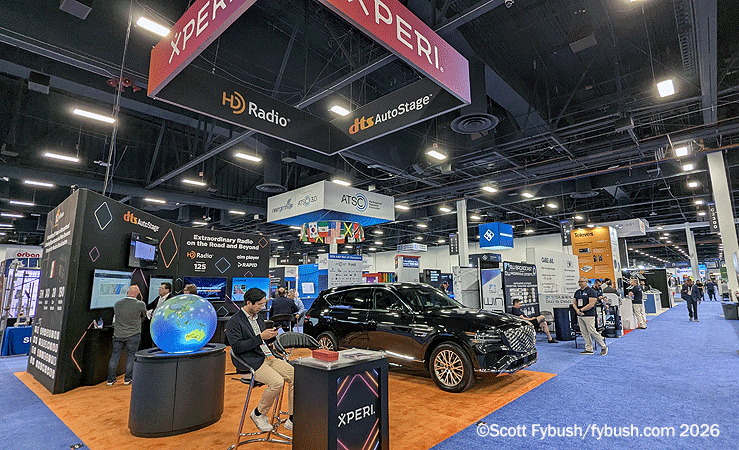 It was an especially busy NAB at this end as your editor took on a new role – after a quarter-century of visiting Las Vegas as a trade publication reporter, engineer and station broker, I’ve added an exciting new hat, adding the ability to help solve radio stations’ problems as the US and Canada representative for Myriad radio automation and scheduling software.
As it turns out, all that time in one booth on the show floor only added to the interesting conversations I was able to have – and there was still plenty of time to see what else was new and worth noting elsewhere on the relocated radio floor, which is now back in the Central Hall of the expanded and renovated Las Vegas Convention Center.
So here are a few of the broad themes from our week-plus in the desert at NAB and at the Public Radio Engineering Conference that precedes the big show.
The regulatory world has shifted in very big ways. We already knew that the FCC has been operating in different ways in the second Trump administration from anything we’ve been accustomed to, but talking to prominent DC lawyers reminded us of just how big the shift has been.
Whatever ownership cap rules might still exist on paper are effectively gone in reality, as shown by the Nexstar-TEGNA deal (despite the court challenges holding it in abeyance) and some lower-profile radio deals that have, for instance, allowed one company to own every commercial radio station in Lincoln, Nebraska.
 That means station brokers will be having more energetic talks with both sellers and buyers about creating clusters that couldn’t have existed under the old rules – and they’ll probably be moving pretty quickly to get deals through a compliant FCC and Justice Department ahead of this fall’s elections and possible new oversight from the next Congress.
Those deals may also extend beyond just radio and TV: as the show was drawing to a close, word started to spread of talks between SiriusXM and iHeart about a merger that could create one mega-company controlling massive pieces of the overall audio production and distribution infrastructure.
Never mind “AI,” the word of the year is “convergence.” Sure, there was “AI” all over the show floor in offerings from all sorts of vendors, and there’s little question that some of the drudgery of broadcast production is going to be changed dramatically by increased AI integration into almost any tool and software you can imagine. It’s not a good time to be a creative talent doing something like station imaging and jingles, for example, because the technology to create those with AI has become both quite good and incredibly cheap.
(And while your editor is no fan of AI implementations that replace human talent and creativity, it was hard not to be amused and impressed by the tongue-in-cheek marketing we found from Las Vegas’ ISP.net Radio, which uses AI-generated “songs” about wireless internet to create an HD Radio subchannel that’s a very clever nonstop promotion for its business.)
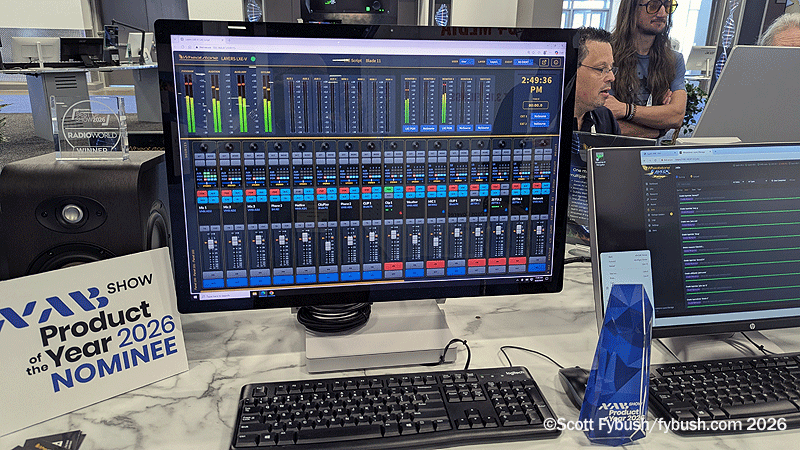 Past all the AI hype, though, there was another very real trend line that ran through so many products on the show floor, and that’s the convergence of so many once-separate pieces of broadcast hardware and software. The big vendors known for their hardware console and router systems – think SAS, Wheatstone, or Logitech – all had offerings that move control of their systems from big physical consoles to screens. And if a screen can control so many aspects of a radio station’s operations, the underlying software doesn’t have to come from a “console” or “router” company, right? It could also come from an “automation” or “processing” company, and it can incorporate so many other functions that once required separate boxes.
Transmitter control and site monitoring? Logitek’s parent company, MaxxKonnect, showed new tools to make that task much more streamlined. There’s continued work going on behind the scenes to take EAS encoding and Nielsen PPM encoding within broadcast software, too.
The way radio programming gets delivered to stations is changing just as fast. With C-band satellite spectrum in the sights of wireless companies, it’s widely known that all of those dishes and hardware receivers will be going away pretty soon, which means there’s a battle brewing among companies looking to replace satellite transmission with internet-based delivery. That’s not just affecting the commercial world; there’s also a trial underway for the Public Radio Satellite System’s delivery system to move to primarily internet-based, and a challenger for public media connectivity in the form of Public Media Management.
The convergence into software is affecting physical studios, too. As rents go up and body counts go down at local stations, we’re hearing about many groups that are very actively downsizing their existing spaces and moving remaining talent to operating from remote locations and home studios – all of which work better when so much that was once done with hardware can be handled with software.
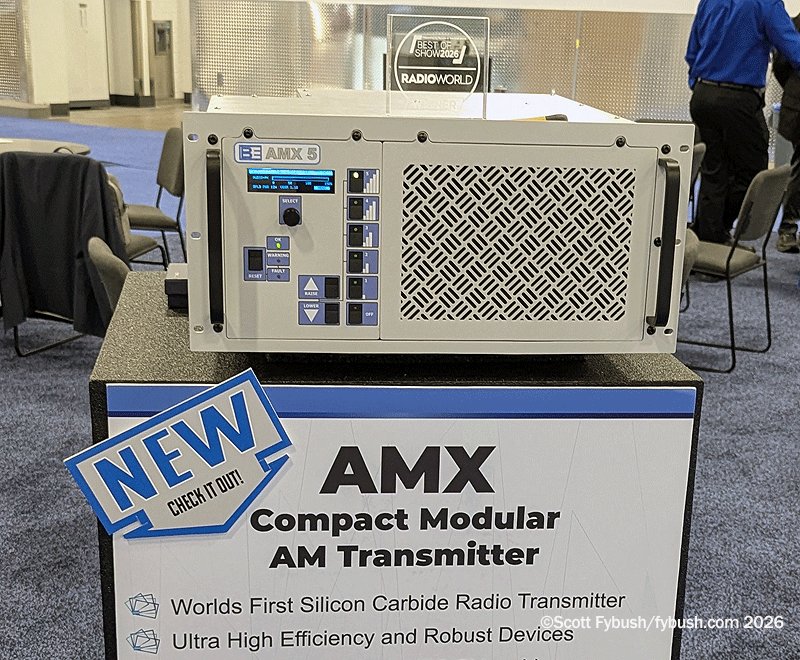 You still need a transmitter, though. For as long as traditional linear broadcasting continues, you still can’t replace that last link in the chain – the transmitter and antenna – with software. It’s been many years since we’ve seen much in the way of new AM transmitters on the show floor, but with so many stations limping along with aging and inefficient transmitters, both Nautel and BE (now with new manager-owners) were showing new lines of solid-state transmitters at power levels from 1000 to 5000 watts. For AM stations that aren’t at death’s door, these new rigs should become popular options to save energy and provide reliable operation that doesn’t require expensive engineering know-how to stay on the air.
(We’ll write more later on about an interesting engineering proposal from the NAB to investigate the possibility of low-power, low-cost AM boosters that could fill in signal holes – it has some technical merit, we think, but might not have any place in the business reality of today’s AM band.)
Smaller turnout, higher interest. The NAB says 58,000 people attended this year’s show, a number that’s barely half of the six-figure peaks that the shows achieved in the late 2010s before the pandemic. While it was certainly a smaller show, though, the station owners and engineers (and a relatively small number of programmers, too) were all in Las Vegas with pretty serious purpose, it seemed.
We were especially heartened by the turnout at the Public Radio Engineering Conference, where we (and the organizers) had feared that budget cuts across the system would make travel impossible for many participants. Instead, PREC drew a solid crowd, both in person and on its virtual option. (And your editor was honored to be able to participate with a talk that explored some of these same themes of studio and software convergence, too.)
 Looking to get into station ownership? Our StationSale division has some great new listings for you, including a major market FM translator opportunity, a profitable Midwest FM, an inexpensive entry into a fast-growing Western market, and a turnkey profitable FM/AM/translator small-market combo that’s ready for a new owner. Drop me a line at scott@fybush.com and I’ll set you up with an NDA and all the details…
And if your noncommercial FM station is ready to think about translators, there’s a filing window coming soon from the FCC and it’s the perfect time to start making plans.

In this week’s issue… WICC, WEBE lose staffers - Remembering NYC's Buc Wild, Canada's mills - New talent in Montreal - More sports radio in Buffalo
In this week’s issue… WEBO mourns morning man - PA's Romigh dies - WESA adds FM signal - LI's Wolf shuffles schedule - New homes for hockey broadcasts
In this week’s issue… Utica's Keeler lands new radio home - Mourning Ron Parker, WPLJ's Ayres, PA's Stei, WFUV's Ahrens - WBEN shuffles schedule - AM returns in Toronto
In this week’s issue… Buffalo remembers Beach - Bauerle out at WBEN - Keeler out in Utica - Saga flips NH formats - AM surrenders in CT, PA, ME - Remembering Butler's Malarkey